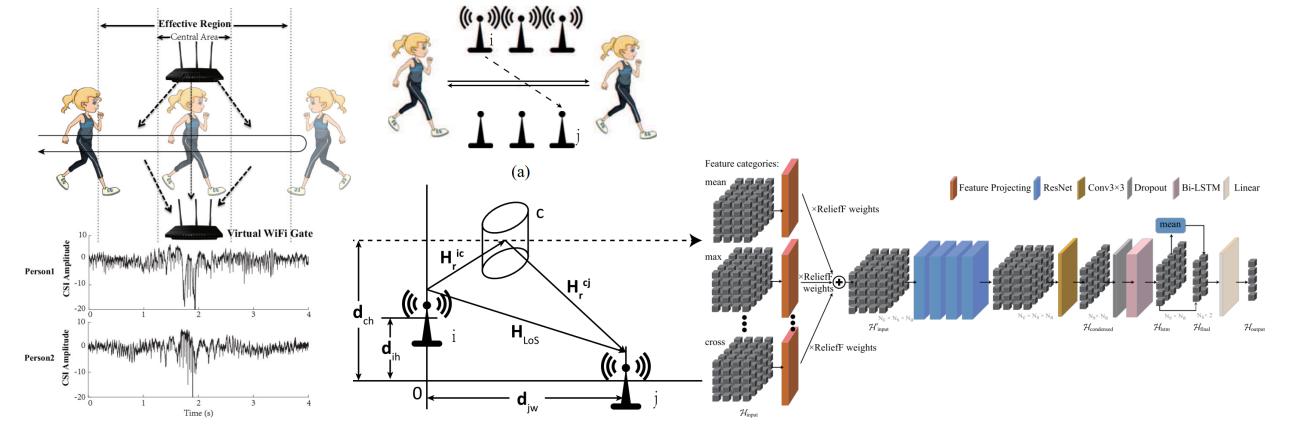
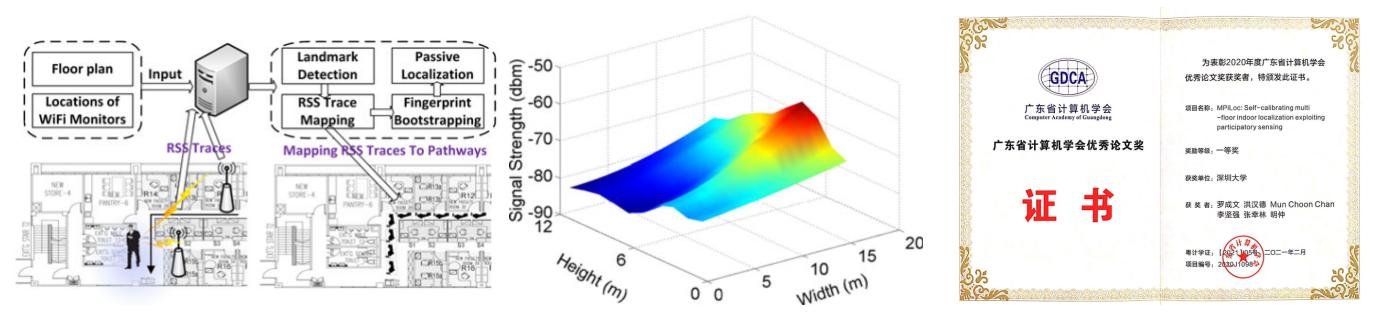
This study explores multimodal collaborative sensing in the Internet of Things (IoT), proposes a theoretical and methodological system for wireless sensing in IoT based on multimodal sensing, constructs an efficient collaborative method and network computing decision model, and proposes a collaborative security theory and method, comprehensively improving the sensing capability, collaborative capability and security assurance capability of IoT systems. (1) Multimodal sensing: Combining WiFi and RFID equal-mode signals, the application boundary of wireless sensing is expanded, realizing efficient human and object sensing in IoT based on wireless. (2) Efficient collaboration: For the collaborative capability of IoT systems, a collaborative construction theory of multi-layer indoor map and positioning database based on swarm intelligence sensing is proposed for the first time. The concept of passive indoor landmarks is introduced, realizing the collaborative construction and self-calibration of indoor map and positioning system of multi-agent system, improving the decision-making and communication efficiency of collaborative computing. (3) Collaborative security: For the security assurance problem of IoT systems, a theoretical connection between data availability and data privacy in swarm intelligence sensing is established, realizing efficient data privacy protection in collaborative learning of swarm intelligence sensing. A software-defined network design based on cloud computing for distributed denial-of-service attacks is constructed, improving network scheduling efficiency and realizing lightweight data protection for IoT systems. Over the past five years, the project's research findings have resulted in over 100 papers published in leading international journals such as IEEE TMC, IEEE/ACM ToN, IEEE TII, IEEE TVT, IEEE COMST, and IEEE IoTJ. The research also received the First Prize for Outstanding Papers from the Guangdong Provincial Computer Association. The multi-modal sensing, efficient collaboration, and security mechanisms for IoT systems proposed in the project have validated the effectiveness of the theories and methods in practical applications, yielding significant economic value.
This achievement won the First Prize in Natural Science from the 2023 Guangdong Provincial Artificial Intelligence Industry Association Science and Technology Award. The project was completed by Luo Chengwen, Li Jianqiang, and Zhang Jin.