Recently, the Guangdong Artificial Intelligence Industry Association announced the winners of the 2022 Science and Technology Awards. Among them, the project "Research and Application of Evolutionary Optimization Technology" led by Professor Zhu Zexuan of the National Engineering Laboratory won the first prize of the Natural Science Award. The winners are: Zhu Zexuan, Ma Xiaoliang, Liang Zhengping, He Shan, Sun Yiwen, and Shen Linlin.
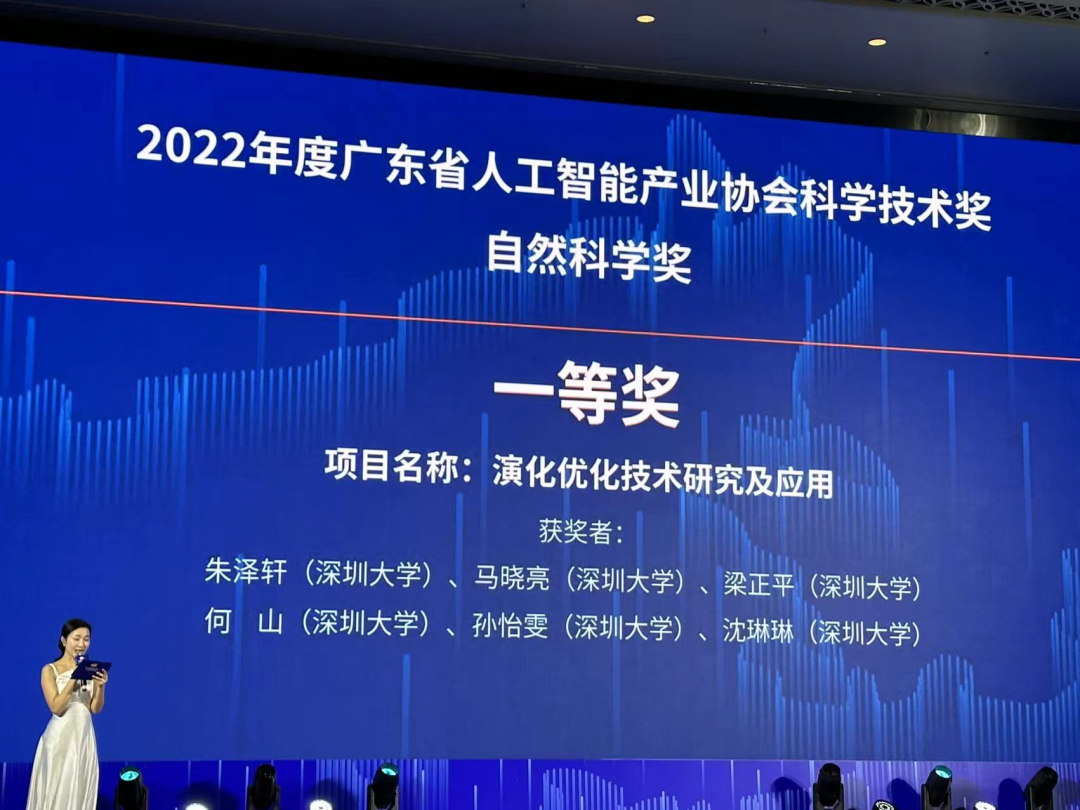
The Guangdong Provincial Artificial Intelligence Industry Association Science and Technology Award in Natural Science is awarded to individuals who have made significant scientific discoveries in basic and applied research in artificial intelligence science and technology, elucidating natural phenomena, characteristics, and laws.
Award-winning project summary:
The team proposed a series of novel evolutionary algorithms for solving complex optimization problems. To address the issue of unclear geometric meaning in Tchebycheff decomposition in multi-objective evolutionary optimization, a concise p-norm-constrained Tchebycheff decomposition was proposed, its geometric meaning theoretically proven. Simultaneously, the R² index was proposed to reduce the computational time complexity of hypervolume from exponential to linear. For hyper-multi-objective optimization problems, reference vectors were constructed by generating well-distributed reference points on a unit hyperplane, and adaptive adjustments to the reference vectors were performed using vector scaling and solution position transformation to handle irregular Pareto fronts. For dynamic multi-objective optimization problems, the team explored the laws of environmental change and identified the similarity patterns of historical changes in evolutionary populations, providing a basis for population transformation and Pareto front approximation. For multi-task optimization problems, a new genetic transformation mechanism was introduced into the evolutionary algorithm to promote knowledge transfer and combined with hyperrectangular search to balance exploration and performance development. The team also proposed a new classification method for co-evolutionary and decompositional multi-objective optimization algorithms, pointing out the challenges and difficulties of existing methods in solving large-scale optimization and complex Pareto frontier problems, providing a reference for subsequent research. The evolutionary algorithms developed by the team have been successfully applied to practical problems such as biological network community detection, hyperspectral image classification, and vehicle dynamic path planning. The results have been published in authoritative journals in evolutionary computing, such as IEEE Transactions on Evolutionary Computation, and other important international journals, gaining recognition and numerous citations from domestic and international peers. A representative work also won the first prize for outstanding papers from the Guangdong Provincial Computer Society.
发送反馈
侧边栏
历史
记录已保存